Showing posts with label Sunday Entry. Show all posts

Sunday, November 23, 2008

Seung Woo Back

Back was born in 1973 in Taejon, Korea.  In 2000 he attended Chungang University in Seoul for his BFA and MFA in photography.  Back is well known for his “Real World” series, where he creates a weird fantasy world by composing multiple objects and buildings.  Tokyo Art Beat says the world that Back creates “is strange, cynical and distorted.”  They explain that “"Real World" is a series of photographs taken in a South Korean theme park that features miniatures of world famous tourist places. Fake architecture and the realistic Seoul landscape coexists there, and the rather calm images evoke an odd sensation and suggest the envy that South Koreans turn towards outside countries.”  Besides his Real World series, Back has also made another series titled “Blow Up,” which features enlarged photographs extracted from on original film made in North Korea.  Tokyo Art Beat states, “Like sneak shots, the images play skillfully on their viewers' voyeuristic interests. The reality of the country, different from the scene we normally see through sometimes exaggerated media reports, gradually slips out from the blown up images.”  Back has had these series exhibited all over the world, from Paris to Seoul. 

Images:

http://english.ganaart.com/artists/back-seung-woo/images/

Gallery/Website:

http://english.ganaart.com/artists/back-seung-woo/images/

Friday, November 14, 2008

Hannah Starkey

Hannah Starkey was born in 1971 in Belfast, England.  Starkey’s photographs use actors placed in deliberate settings that “reconstruct scenes from everyday life with the concentrated stylisation of film” (the Saatchi Gallery).  Also contained in Starkey’s photographs are “women engaged in regular routines such as loitering in the street, sitting in cafes, or passively shopping.”  Her work manages to capture these mundane yet daily activities with an air of ‘relational detatchment.’ According to Saatchi Gallery, “Her still images operate as discomforting ‘pauses’; where the banality of existence is freeze-framed in crisis point, creating reflective instances of inner contemplation, isolation, and conflicting emotion.  Starkey enhances the feelings her images create through a careful and controlled of composition and setting.  Saatchi Gallery states that “Starkey often uses composition to heighten this sense of personal and emotional disconnection, with arrangements of lone figures seperated from a group, or segregated with metaphoric physical divides such as tables or mirrors.”  Starkey currently lives and works in London. 

Images:

http://www.saatchi-gallery.co.uk/blogon/upload/2007/06/hannahstarkeyil.jpeg

http://www.portfoliocatalogue.com/40/01.jpg

http://www.tanyabonakdargallery.com/artist.php?art_name=Hannah%20Starkey

http://www.tanyabonakdargallery.com/artist.php?art_name=Hannah%20Starkey

Gallery representing artist/artist website:

http://www.saatchi-gallery.co.uk/artists/hannah_starkey.htm

Interview:

http://www.wallpaper.com/news/Interview:_Hannah_Starkey/1295

Sunday, November 9, 2008

Laura Letinsky

Laura Letinsky was born  in Winnipeg, Manitoba, Canada in 1962.  She studied photography at University of Manitoba, Winnipeg, where she recieved her BFA in 1986.  She then went on to recieve her MFA from Yale in 1991.  Letinsky has had work exhibited at the Museum of Modern Art in New York, the Art Institute of Chicago, and the Canadian Museum of Contemporary Photography in Ottowa, to name a few.  Letinsky’s first series of published photographs were titled Venus Inferred, and consist of intimately engaged heterosexual couples, in Letinsky’s attempt to show the viewer what love looks like.  According to the Museum of Contemporary Photography, “Letinsky’s pictures of love are composed of Necco Wafer colors – peach, blue, green and yellow – and contained within an elegant formality. These visual attributes are fully unleashed in her most recent series, Morning and Melancholia, still-life compositions discovered in the remains of daily meals that reference Dutch and Flemish painting.”  The Museum of Contemporary Photography then goes on to say that both series of photographs “offer an extended essay on fragility, the domestic arena and, according to Letinsky, the photograph’s transformative qualities.”  Letinksy is currently teaching at the University of Chicago, where she serves as a Professor and Chair. 

Images:

http://www.mocp.org/collections/permanent/uploads/Letinsky1996_223.jpg

http://mouthtomouthmag.com/mermaid.jpg

http://www.flowerseast.com/Originals/MISC/39364.jpg

http://nymag.com/images/2/daily/entertainment/08/04/11_ac1_lg.jpg

Interview:

http://images.google.com/imgres?imgurl=http://mouthtomouthmag.com/mermaid.jpg&imgrefurl=http://mouthtomouthmag.com/letinsky.html&h=470&w=600&sz=297&hl=en&start=12&um=1&usg=__HIHUm5ZYuRIBj2BFqkrfEhaJSQU=&tbnid=dbvl6Dv08cdbYM:&tbnh=106&tbnw=135&prev=/images%3Fq%3Dlaura%2Bletinsky%26um%3D1%26hl%3Den%26client%3Dsafari%26rls%3Den-us%26sa%3DN

Gallery Representing Artist/Artist Website:

http://www.josephbellows.com/artists/laura-letinsky/bio/


Sunday, November 2, 2008

Charles Sheeler

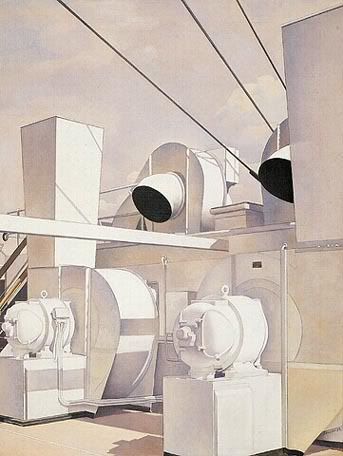
Charles Sheeler was born in Philadelphia in 1883.  In 1903 he studied at the Pennsylvania Academy of Fine Arts, with William Merritt Chase as his professor.  After a trip to Paris in 1908 “he experienced his conversion to Cézanne, Picasso, Braque, and Matisse” (Artchive).  After returning to Philadelphia, Sheeler began to do commercial photography to support his painting.  During this time he worked with Morton Schamberg.  It was then that Sheeler’s style began to emerge, he had a “talent for high-definition photography, with stark, plain, and well-Judged masses of tone, [he] shied away from human documentary: he avoided figures in favor of near-abstract subjects, images of anonymous architecture, such as the sides of barns in Bucks County, Pennsylvania - plain American vernacular” (Artchive).  Sheeler’s preference of shooting anonymous architecture “came from his belief that a common line of empirical functionalism was the "unseen soul" of American tradition, linking the old barn to the new industrial plant” (Artchive).  Sheeler had a long career in photography and painting.  In 1927 he was hired by Ford Motor Company to photograph its River Rouge plant.  Sheeler was obviously quite impressed with the factory, stating that “Our factories are our substitute for religious expression.”  Sheeler photographed the factories in such a way that this could almost be true.  “The interiors of the mighty factory buildings are high, clean, invested with a numinous light, and free of all human presences except when they are needed to give scale” (Artchive).  Sheeler also expressed his feelings about big industry in his famous painting American Landscape done in 1930.  “It holds no nature at all, except for the sky (into which a plume of effluents rises from a tall smokestack) and the water of a dead canal. Whatever can be seen is man-made, and the view has a curious and embalmed serenity, produced by the regular cylinders of silos and smokestack and the dark authoritarian arms of the loading machinery to the right” (Artchive).  Charles Sheeler died in 1965, at the age of 81.

Images:

http://www.nga.gov/exhibitions/2006/sheeler/images/commercial/fullscreen_fig_06.jpg

http://www.metmuseum.org/special/Charles_Sheeler/images/5.L.jpg

http://xroads.virginia.edu/~1930s2/Time/1932/sheeler.jpg

http://i42.photobucket.com/albums/e329/jaimegh/art%20fuck/CharlesSheeler-UpperDeck.jpg

Interview:

http://www.aaa.si.edu/collections/oralhistories/transcripts/sheele58.htm

Artist website/gallery:

http://www.getty.edu/art/gettyguide/artMakerDetails?maker=2079

Friday, October 24, 2008

Richard Serra

Richard Serra was born in San Francisco in 1939.  He attended University of California both and Berkley and Santa Barbara, and graduated in 1961 with a B.A. in English Literature.  Before attending Yale for gradschool, he worked in steel mills in order to support himself.  In 1964 he graduated from Yale, having obtained both a BFA and MFA.  Serra’s work that emerged in the 1960’s, and “focused on the industrial materials that he had worked with as a youth in West Coast steel mills and shipyards: steel and lead. A famous work from this time involved throwing lead against the walls of his studio. Though his casts were created from the impact of the lead hitting the walls, the emphasis of the piece was really on the process of creating it: raw aggression and physicality, combined with a self-conscious awareness of material and a real engagement with the space in which it was worked” (Art:21).  Always working in the minimalist style, his work is now famous for that physicality, only on a much larger scale.  In 1996 he released his “Torqued Ellipses” series “which comprise gigantic plates of towering steel, bent and curved, leaning in and out [and] carve very private spaces from the necessarily large public sites in which they have been erected” (Art:21).  Serra’s most recent work is a 60 foot-tall “Charlie Brown” monument which is erected in the courtyard of a San Francisco office.  Currently Serra lives in New York and Nova Scotia.

Images:

http://images.google.com/imgres?imgurl=http://www.diacenter.org/exhibs_b/serra/serra-exhibs_b-top.jpg&imgrefurl=http://www.diacenter.org/exhibs_b/serra/&h=405&w=320&sz=20&hl=en&start=20&um=1&usg=__FQiNHN56zRhEenjFy7IcxD6GPo0=&tbnid=4LqeHpV5UBG6zM:&tbnh=124&tbnw=98&prev=/images%3Fq%3Drichard%2Bserra%26um%3D1%26hl%3Den%26client%3Dsafari%26rls%3Den-us%26sa%3DN

http://www.akiraikedagallery.com/RichardSerra_MarilynMonroeGrataGarbo2.jpg

http://img.timeinc.net/time/photoessays/2007/richard_serra/richard_serra_09.jpg

http://upload.wikimedia.org/wikipedia/commons/d/dd/Richard_Serra_View_Point.jpg

Interview:

http://www.pbs.org/art21/artists/serra/clip2.html

Gallery representing artist/artist website:

http://www.gagosian.com/artists/richard-serra

Tuesday, October 21, 2008

Jonathan Swift

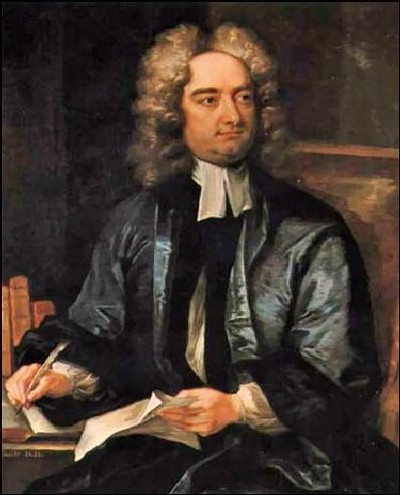
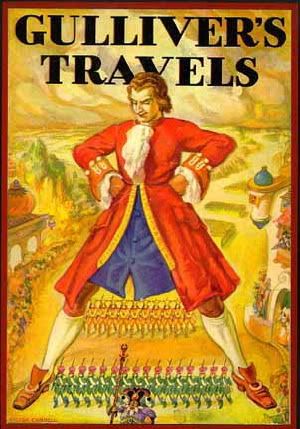
Jonathan Swift was born in Dublin, Ireland November 30th, 1667.  During his lifetime Swift was an Anglo-Irish satirist, an essaysit, and a poet.  He also worked for the Whigs and then the Tories as a political pamphleteer.  His best known work is Gulliver’s Travels.  He is also well known for A Modest Proposal, A Journal to Stella, Draipier’s Letters, The Battle of the Books, An Argument Against Abolishing Christianity, and A Tale of Tub.  According to Wikepedia, “Swift is probably the foremost prose satirist in the English language, and is less well known for his poetry.”  Swift attended Dublin University in 1682, where he recieved his B.A.  When political troubles arose in Ireland due to the Glorious Revolution, Swift was forced to flee to England, where he obtained a posistion as secretary to Sir William Temple, an English diplomat.  In 1692, Swift recieved his M.A. from Hertford College, Oxford University.  In 1694 Swift was ordained a priest in the Established Church of Ireland.  During the years 1707 to 1709 Swift became very politically active.  During the 1720’s Swift began writing Gulliver’s Travels, back then known as Travels into Several Remote Nations of the World, in Four Parts, by Lemuel Gulliver, first a surgeon, and then a captain of several ships.  Lemuel Gulliver was one of Swift’s pseudonyms that he published work under.  According to Wikepedia, Much of the material reflects his political experiences of the preceding decade. For instance, the episode when the giant Gulliver puts out the Lilliputian palace fire by urinating on it can be seen as a metaphor for the Tories' illegal peace treaty; having done a good thing in an unfortunate manner.”  Swift’s health began to decline the in the late 1730s and early 1740s, many disputing whether or not he was also insane.  In 1742 Swift suffered a stroke and lost the ability to speak. He died October 19th, 1745.  Swift is considered a master of both the Horatian and Juvenalian styles of satire. 

Images:

http://upload.wikimedia.org/wikipedia/commons/7/7e/Jervas-JonathanSwift.jpg

http://members.shaw.ca/stodmyk/misc/GulliverLeashed.jpg

http://i23.photobucket.com/albums/b360/lilliputhome/gullivers_travels.jpg

http://blog.sixwise.com/photos/images/images/91/555x360.aspx

No interview is available.

Website:
http://cepa.newschool.edu/het/profiles/swift.htm

Sunday, October 12, 2008

Matthew Barney

Barney was born in San Francisco in 1976.  Six years later, he moved to Idaho with his family.  His parents divorced, and Barney remained in Idaho, living with his father and playing football on the highschool team, while making visits to his mother in New York City, where he was introduced to the art world.  According to art:21 “This intermingling of sports and art informs his work as a sculptor  and filmmaker.”  Barney graduated from Yale in 1991, and “entered the art world to almost instant controversy and success” (art:21).  His best known works are the “CREMASTER” films which he created and produced. CREMASTER is a series of 5 films released out of order, and star Barney in numerous roles, such as a magician, a satyr, Harry Houdini, a ram, and the infamous murderer Gary Gilmore.  ‘CREMASTER’ “refers to the muscle that raises and lowers the male reproductive system according to temperature, external stimulation, or fear” (art:21).  The CREMASTER series are a mix of mythology, history, and autobiography.  Upon release and exhibition, they have recieved mixed reviews. 

Images:

http://www.ocma.net/img/20_Matthew-Barney-Cremaster-72-.jpg

http://tk.files.storage.msn.com/x1p78D8DlBI2gYrFArhkJ8_iRjz9Iw6VW8u2HsvGulMmgHRO8jr0ix3dqWRiRwzGsUGqU9bI9U1awkuoWOeIY_Ad1Aw0zFrEu8tAGtcn49l7N4XFwAhqkcwcPjf1Y-XYmvA7T8S3bMuuZw

http://www.filmtotaal.nl/images/newscontent/be6aa80.jpg

http://www.artgallery.nsw.gov.au/__data/page/3601/cremastercycle1marti.jpg

Gallery representing artist:

http://www.gladstonegallery.com/barney.asp

Artist Interview:

http://www.youtube.com/watch?v=VJfI1LRK0tc

Artist website:
http://www.cremaster.net/

Friday, October 3, 2008

Philip-Lorca diCorcia

DiCorcia was born in Hartford, Conneticut in 1951.  He studied at the School of the Museum of Fine Arts, in Boston.  He then went to Yale, where he recieved a Masters of Fine Art in photography.  DiCorcia’s style can be said to be a mix between informal snapshots and staged compositions.  Using a carefully planned staging, he takes everyday occurrences beyond the realm of banality, trying to inspire in his picture's spectators an awareness of the psychology and emotion contained in real-life situations” (Wikepedia).  This style probably developed out of diCorcia’s earlier career, where he would take family and friends and place them in fictional interior tableaus, making the viewer think that they were snapshots of the everyday life, when in fact they were staged photos.  DiCorcia then moved on to photographing random people in urban spaces around the world.  He achieved this by hiding lights in the pavement, which would illuminate a random subject in a unique way, separating them from everyone else who happened to be on the same street.  These photographs give “a sense of heightened drama to the passers-by accidental poses, unintended movements and insignificant facial expressions.  Even if sometimes the subject appears to be completely detached to the world around him, diCorcia has often used the city of the subject's name as the title of the photo, placing the passers-by back into the city's anonymity” (Wikepedia).  DiCorcia currently lives and works in New York.

Images:

http://www.albrightknox.org/acquisitions/acq_2002/images/di_Corcia.jpg


http://paulturounetblog.files.wordpress.com/2007/12/pl-dicorcia_head13.jpg


http://images.artnet.com/artwork_images_424045384_253981_philip-lorca-dicorcia.jpg


http://www.hit.ac.il/staff/ShlomoA/Photography/november/Philip-EddieAnderson.jpg


Interview:

http://www.lacan.com/frameXIV9.htm


Gallery representing artist/artist website:

http://www.icaboston.org/exhibitions/permanent-collection/artists/diCorcia/

Sunday, September 28, 2008

Michelangelo Antonioni

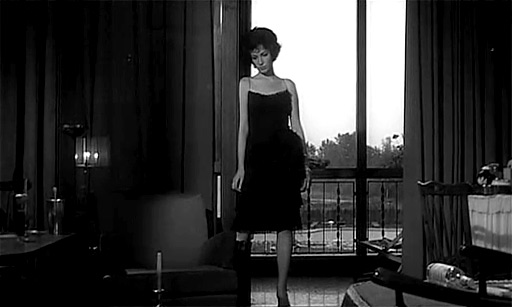
Michelangelo Antonioni was born on September 29th, 1912 in northern italy.  He died July 30th, 2007, at the age of 94.  Antonioni graduated from University of Bologna with a degree in economics, and in 1940 he moved to Rome, where he began working for Cinema, the official fascist magazine with Vittorio Mussolini as editor.  After being fired within the first few months, Antonioni enrolled at the Centro Sperimentale di Cinematografia, where he briefly studied film technique.  After three months he left, and was drafted into the army.  Antonioni began making his first short films in the 1940s, which were classified as neorealist, since they were semi-documentaries studying the lives of ordinary working class people.  In the 1950s Antonioni produced his first feature length film, this time depicting the middle class.  The style of Antonioni's films were radical and new at the time, gaining him international success.  In his film Le Amiche, he "experimented with a radical new style: instead of a conventional narrative, he presented a series of apparently disconnected events, and he used the long take frequently. This style is potentially frustrating due to its slow pacing and lack of forward momentum, although it is very fascinating in visual and conceptual terms."  These stylistic techniques soon became Antonioni's signature vision, and help emphasize his stories, which tend to be about social alienation.  Antonioni also tended to emphasize the meaningless of peoples lives, and how deep down human-beings lives are purposeless and shallow.  According to film historian David Bordwell, in Antonioni's films "Vacations, parties and artistic pursuits are vain efforts to conceal the characters' lack of purpose and emotion. Sexuality is reduced to casual seduction, enterprise to the pursuit of wealth at any cost."   Antonioni is considered very influential in the film world, and is known for "encouraging filmmakers to explore elliptical and open-ended narrative" (Bordwell).  

Images:

Interview:

Gallery representing artist:
No artist website available

Saturday, September 20, 2008

Joel Sternfeld


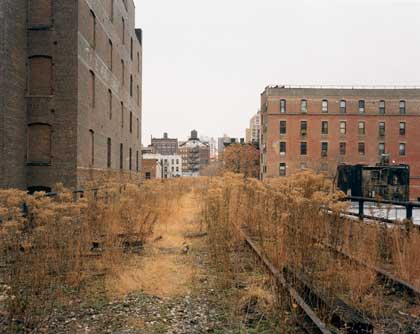
Born 1944 in New York City, Sternfeld graduated from Dartmouth College in 1965 with a BA in Art.  After studying the color theory of Johannes Itten and Josef Albers, he began making color photographs in the 1970s.  Starting out with small and medium format cameras, he eventually moved on to shoot large format, giving his work the crisp details that it is known for.  In 1987 Sternfeld released his American Prospects series, which “combined . . .  an insightful and ironic view of his subjects” (The Getty Museum).  In 1996 Sternfeld began to travel and document tragic events in American history, calling the series: On This Site: Landscapes in Memoriam.  Applying his careful use of color, Sternfeld photographed the site where Martin Luther King was murdered, and the place where Rodney King was beaten.  In 2001 with his Stranger Passing series, Sternfeld switched from landscapes to full length portraits, recording the peole he met as he traveled across America.  “Each picture tells a story via the person’s physical appearance and the rich details of their surroundings” (The Getty Musuem).  Sternfeld’s most recent series done in 2006, Earth: Esperimental Utopias in America “explores the sites of past and present idealized communities” (The Getty Museum).  Currently, Sternfeld teaches photography at Sarah Lawrence College.

Images:

http://iamgros.com/blog/wp-content/uploads/2007/03/joel_sternfeld_blanket_blog.jpg

http://caraphillips.files.wordpress.com/2007/12/sternfeld1.jpg

http://collegerelations.vassar.edu/images/releases/070525.utopian_dropcity.jpg

http://www.cabinetmagazine.org/issues/3/assets/images/main/sternfeld_2.jpg

Interview:

No interview available.

Gallery Representing artist/artist website:

http://www.luhringaugustine.com/index.php?mode=artists&object_id=67

Saturday, September 13, 2008

Gregory Crewdson

Gregory Crewdson was born in Brooklyn, New York on September 26, 1962.  After seeing a Diane Arbus retrospective at the Museum of Modern Art in New York City, he became interested in photography.  He studied photography at the State University of New York at Purchase, where he recieved a B.A in 1985.  While there he was classmates with Jan Groover and Laurie Simmons.  Crewdson then went on to Yale for an M.F.A. in photography, which he recieved in 1988.  One of Crewdson’s early series, Natural Wonder took place in Lee, Massacusetts, where he had also shot his series of portraits for his thesis at Yale.

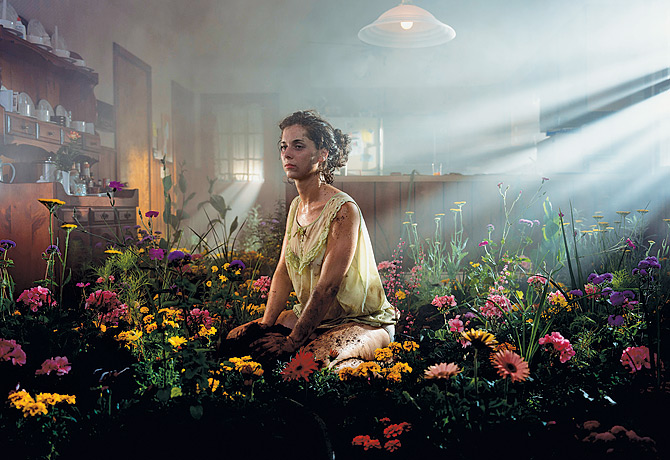
In 1992 Crewdson developed his Natural Wonder series, “in which birds, insects, and mutilated body parts are presented in surreal yet mundane domestic settings” (Guggenheim museum).  Crewdson’s next series, Hover, (1995) turned away from brightly colored imagery, and switched to “black-and-white bird’s-eye views of strange situations set in the streets and backyards of Lee” (Guggenheim museum). 

It wasn’t until Crewdson’s Twilight series in 1998 that the surreal and cinematic elements of his imagery began to emerge, as he re-introduced color into his large scale prints.  Crewdson’s photos have become more and more elaborate, “requiring dozens of assistants, Hollywood-style lighting, and specially crafted stage sets” (Guggenheim museum).  Crewdson’s photos, although set in American suburbia, are eerie and dark, and play with an element of the surreal.  Although at first glance some of his photos seem to depict normal surburbia, upon closer examination one begins to feel the tension and unease that his photographs create. 

Crewdson currently teaches photography at Yale, and lives and works in Lee, New Haven, and New York. 


Imagery:

http://coromandal.files.wordpress.com/2008/05/amstaged_0305.jpg


http://blog.camera80.ro/images/2006/november/gregory-crewdson-6.jpg


http://vienofoto.files.wordpress.com/2008/05/gregory-crewdson.jpg


http://sarahh.net/blog/wp-content/uploads/2008/06/00027gyt.jpg


Interview:

http://www.sitesantafe.org/exhibitions/virtualgalleries/frcrwan/crewdsonqa.html


Gallery representing artist:

http://www.luhringaugustine.com/index.php?mode=artists&object_id=66


No artist website available.