Wednesday, September 17, 2008

Surrealism

Descriptive word: bizarre

“Surrealism, n. Pure psychic automatism, by which it is intended to express, whether verbally or in writing, or in any other way, the real process of thought. Thought’s dictation, free from any control by the reason, independent of any aesthetic or moral preoccupation."

-André Breton

Jones, Jonathan. “Arts: Andre in wonderland: In 1928 the first photobooth arrived in Paris - and for Breton and the surrealists, it was a dream come true.”  The Guardian (London).  16 June 2004, final edition: p. 12.

Jonathan Jones is a staff writer for the London Guardian newspaper.  He writes for the arts and design section of the newspaper.  In his article of André Breton and surrealism, he writes briefly about the rise of the surrealism revolution with its founder Breton, and the influence that it had in photography.  Jones states that Breton’s definition for surrealism is “pure physic automatism,” which flowed together well when the first automatic photo machine (called a photomaton) was invented and released in Paris.  According to Jones, “the photomaton was a readymade surrealist photography that removed the conscious, controlling mind of the photographer and took a stream of images too quickly for the sitter to compose her or himself in any but the most basic ways. The close range of the portraits and the flat background add to the sense of being surprised, taken aback, even abused, that we feel after sitting for a strip of passport pictures. The brutality that makes photomaton portraits uncomfortable makes them, for the surrealists, insightful.”  Portraiture and especially self-portraiture were very common in surrealism, because they were very fascinated by the “self.”  As Jones points out, the majority of the photomaton portraits of Breton and his group show them with their eyes closed.  In accordance with Breton’s manifesto of 1924, this will help us to recognize “the omnipotence of the dream.”  Towards the end of Jones’s article, he analyzes the photomaton portraits in a contemporary light.  Calling them “anti-aesthetic, deliberately banal, photo-based art” he believes them to be antecedents of Andy Warhol’s work.

While my work is not about examining the self or dreams, I think it can definitely benefit from the surreal movement’s exploration of the bizarre and uncanny.  Since I am experimenting in combining imagery to create a made up space, I think it is appropriate to consider the history and process behind this movement. Photography played a big part in surrealism with its departure from the ordinary use of a camera, and instead of using as a practical tool to record what is in front of it, it was used to create what the artist imagined.  I think this theory can be useful to my process.

Photo:

http://www.bbc.co.uk/photography/genius/gallery/images/ray.jpg


Saturday, September 13, 2008

Gregory Crewdson

Gregory Crewdson was born in Brooklyn, New York on September 26, 1962.  After seeing a Diane Arbus retrospective at the Museum of Modern Art in New York City, he became interested in photography.  He studied photography at the State University of New York at Purchase, where he recieved a B.A in 1985.  While there he was classmates with Jan Groover and Laurie Simmons.  Crewdson then went on to Yale for an M.F.A. in photography, which he recieved in 1988.  One of Crewdson’s early series, Natural Wonder took place in Lee, Massacusetts, where he had also shot his series of portraits for his thesis at Yale.

In 1992 Crewdson developed his Natural Wonder series, “in which birds, insects, and mutilated body parts are presented in surreal yet mundane domestic settings” (Guggenheim museum).  Crewdson’s next series, Hover, (1995) turned away from brightly colored imagery, and switched to “black-and-white bird’s-eye views of strange situations set in the streets and backyards of Lee” (Guggenheim museum). 

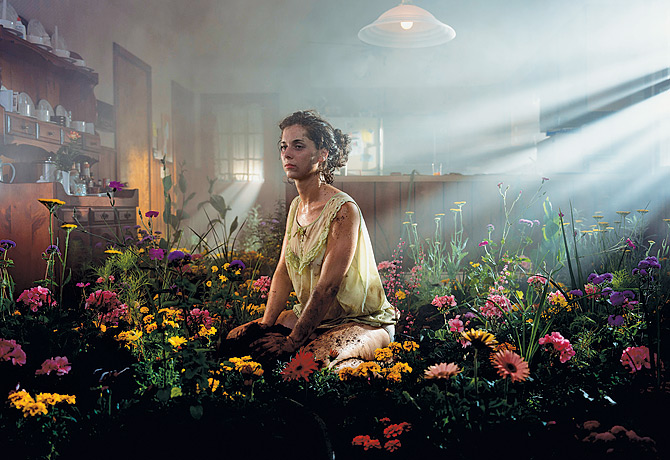
It wasn’t until Crewdson’s Twilight series in 1998 that the surreal and cinematic elements of his imagery began to emerge, as he re-introduced color into his large scale prints.  Crewdson’s photos have become more and more elaborate, “requiring dozens of assistants, Hollywood-style lighting, and specially crafted stage sets” (Guggenheim museum).  Crewdson’s photos, although set in American suburbia, are eerie and dark, and play with an element of the surreal.  Although at first glance some of his photos seem to depict normal surburbia, upon closer examination one begins to feel the tension and unease that his photographs create. 

Crewdson currently teaches photography at Yale, and lives and works in Lee, New Haven, and New York. 


Imagery:

http://coromandal.files.wordpress.com/2008/05/amstaged_0305.jpg


http://blog.camera80.ro/images/2006/november/gregory-crewdson-6.jpg


http://vienofoto.files.wordpress.com/2008/05/gregory-crewdson.jpg


http://sarahh.net/blog/wp-content/uploads/2008/06/00027gyt.jpg


Interview:

http://www.sitesantafe.org/exhibitions/virtualgalleries/frcrwan/crewdsonqa.html


Gallery representing artist:

http://www.luhringaugustine.com/index.php?mode=artists&object_id=66


No artist website available.

Wednesday, September 10, 2008

New Topographics Movement


Descriptive word: Realism

“To work in a way integrated with architecture, I think the work we’re speaking about here is not a question of putting my work in his building but a question of using that building and the activities in that building as a way of generating a dialogue in images. The work is not even site-specific, it’s really site-generated. It’s something that’s made exclusively for that space and that space with its present series of functions. In that sense it becomes like most works today ephemeral.”
Lewis Baltz

Grundberg, Andy.  “Review/Photography: Beauty and Challenge in Modern Landscape.”  The New York Times.  13 July 1990, late final ed. : C14. 

Andy Grundberg is a an art critic and administrative chair of photography at the Corcoran College of Art and Design.  In his article in the New York Times, Grundberg compares the aesthetics of the New Topographics Movement to the more contemporary “New American Pastoral” movement.  Grundberg discusses the impact that the New Topographics movement has had on the history of photographic landscapes, especially since Ansel Adams.  Grundberg points out that both the New Topographics and American Pastoral movements take a critical viewpoint when photographing landscapes.  Grundberg also discusses the different ways that artists from these two movements chose to portray the relationship between beauty and the environment.  He states about the two movements that “both reflect photographers' attempts to devise a documentary style able to call attention to environmental issues that defy conventional description.”


The New Topographics style has influenced my work in many ways.  It has made me more aware of the juxtaposition of the man-made and nature, and how we choose to view the environment that we live in.  I think the bleak anonymity of the photos in the New Topographics is an interesting departure from the romanticized landscapes that the art world had been accostomed to for so long.   I find it interesting that the desolate, anonymous, sometimes deadpan style of the New Topographics movement is clevery used to generate a narrative, using the buildings as “dialogue.”  This is ultimately my aim in creating a series of photos, but  I have yet to decide on what exactly I am trying to say. 

Images:

http://images.google.com/imgres?imgurl=http://www.mocp.org/collections/permanent/uploads/Baltz2001_5.jpg&imgrefurl=http://www.mocp.org/collections/permanent/baltz_lewis.php&h=283&w=430&sz=39&hl=en&start=9&um=1&usg=__6ncbdQwA8Ux92vWNBQHl4HPauPc=&tbnid=GUwc5-PxrU5KFM:&tbnh=83&tbnw=126&prev=/images%3Fq%3Dlewis%2Bbaltz%26um%3D1%26hl%3Den%26client%3Dsafari%26rls%3Den-us%26sa%3DG

Sunday, September 7, 2008

Complete

Paul Thulin has read your blog up to this point/entry. Your blog is currently up to date and complete.

Saturday, September 6, 2008

Beate Gütschow


Beate Gütschow was born 1970 in Mainz, Germany.  She studied at the School of Fine Arts in both Oslo and Hamburg.  Throughout her studies she had classes with Johannes Blume and Wolfgang Tillmans.  Gütschow has had work in group shows, but recently she had her first solo show at the Museum of Contemporary Photography, Colombia College Chicago, and at Danziger Projects.  Currently she lives and works in Berlin. 

Gütschow produces digital “constructed” photographs of both landscapes and cityscapes.  She “draws on the work and traditions of Romanitic-era painters and photo legends Lewis Baltz and Bernd and Hilla Becher” (Egan, Natasha & Ono, Akiko).  Although at first glance her landscapes may seem like tranquil pastoral scenes, they are actually created to raise questions of control, inauthenticity, and the pursuit of perfection.  According to Egand and Ono, Gütschow’s two bodies of work “compel the viewer to think about humankind’s celebration of nature and our ceasless desire to control it.”  Differing greatly at first glance from her landscapes, her cityscapes seem immediately eerie and bizarre.  Gütschow’s constructed dystopian architecture has an almost recognizable qualitity to it, although eventually one realices that the scene they are looking at is actually nonexistant.  However different the two series may be, they both share Gütschow’s paintstaking eye for detail.  In reference to her constructed images Egan and Ono state “. . . each detail, including the subtle nuances of the palette and light, is carefully controlled, culled from an archive of images taken specifically for use in these seamless collages.”


Images:

http://www.aperture.org/store/books-preview-bio.aspx?ID=587


Review:

http://www.jmcolberg.com/weblog/2007/10/review_lss_by_beate_gtschow_1.html


Gallery representing artist:

http://www.mocp.org/exhibitions/2007/10/beate_guetschow.php


No website is available for this artist.

Wednesday, September 3, 2008

Thursday posting

Topic: Deadpan Aesthetic

Descriptive word: objective

“The adoption of a deadpan aesthetic moves art photography outside the hyperbolic, sentimental and subjective. . . . Deadpan photography may be highly specific in its description of its subjects, but its seeming neutrality and totality of vision is of epic proportions.”

-Charlotte Cotton, The Photograph as Contemporary Art

CHARLES, HAGEN. "Review/Photography; Making Industrial Buildings Look Like Butterflies." New York Times (1993):15-.

The author Charles Hagen is a photographer, teacher and writer living in Brooklyn, New York.  Hagen works as an associate professor of art at University of Connecticut, as well as a writer for Artforum, Afterimage, and Aperture.  Hagen is also a critic for the New York Times.  In his article Hagen references Bernd and Hilla Becher as successfully applying the deadpan aesthetic to give their photos of buildings a cohesive neutrality.  It is Hagen’s belief that the Becher’s persistent and meticulous approach to photographing industrial structures reduces them to variations of ideal forms, and “arranged in their regular grids, the works seem like excerpts from a collection of particularly exotic mechanical butterflies.”  Hagen also states that through the Becher’s use of the deadpan aesthetic, they are only relying on the camera as a tool to record objectivity, instead of to express emotion. 


I am interested in using the deadpan aesthetic to remove traces of emotion in my photographs.  I think my photos will be much more successful if they merely record what is in front of the camera, instead of what I want the camera to capture and express.  Using the deadpan aesthetic will really enhance the mundane and banal scenes that I choose to shoot.

Image: http://www.masters-of-fine-art-photography.com/02/artphotogallery/database/becher_01.jpg


Monday, September 1, 2008

Thomas Struth

Thomas Struth was born in Germany in 1954.  After studying painting under Peter Kleeman and Gerhard Richter, he switched mediums and began to study photography under Bernhard and Hilla Becher.  His early work, begun in 1978, consists mostly of black and white cityscapes which "offer vast perspectives punctuated by a seemingly endless rhythm of architectural facades" (Guggenheim Museum).  Struth shot these photographs and similar ones throughout Europe, America, and Tokyo. 
In the mid 1980s Struth started a series of color and black and white portraits of individuals and families.  This series grew out of Struth's belief that photography is "a tool of scientific origin for psychological exploration" (Guggenheim Museum).  This ongoing series explores how we are conditioned to see ourselves, and how our identities help to condition these perceptions.  The idea behind Struth's series of portraits carried over into his best known work, which are his Museum Photographs. 
 These large-format color prints capture both anonymous individuals and crowds as they gather to look at some of the western world's most famous works of art.  With this series of photos Struth "emphasizes museum-going as a complex social ritual of seeing and being seen, one in which the museum itself functions as both custodian and broker of cultural capital" (Guggenheim Museum).  
In the last 10 years Struth has also photographed natural landscapes, intimate nature studies, celebrated architectural monuments, and Chinese cityscapes.  Struth now lives and works in Dusseldorf, Germany.  

Images:
http://www.museumlab.org/wp-content/photos/Thomas_Struth_at_the_Prado.JPG
http://www.designboom.com/tools/WPro/images/blog19/ts2.jpg
http://images.artnet.com/artwork_images_424713569_401810_thomas-struth.jpg
http://horsesthink.com/wp-content/uploads/2007/08/skyscrapers.jpg

Interview with Thomas Struth:
http://www.db-artmag.de/2003/10/e/2/87.php

Gallery representing Thomas Struth/artist's website:
http://www.thomasstruth.net/