Wednesday, September 24, 2008

Utopian Landscapes

Idealistic

"….This world needs Utopias as it needs fairy stories. It does not matter so much where we are going, as long as we are making consciously for some definite goal. And a Utopia, however strange or fanciful, is the only possible beacon upon the uncharted seas of the distant future."  

-       Hendrik Willem Van Loon

Lorinc, John.  “In the utopian city there’s no trash, no graffiti – and no people.”  National Post

            (Canada) 22 Mar. 2003, Saturday ed. : SP4. 

John Lorinic is an anchor and editor for CNNRadio.  In his article he discusses and reviews a book by art historian Ruth Eaton titled “Ideal Cities:  Utopianism and the (un)built environment.”  Lorinc begins his article by mentioning that as Eaton states, “the human desire to build utopian societies as a response to the grim realities of actual cities stretches back to the very dawn of civilization.”  An important figure in the Utopian movement was Le Corbusier, a “misanthropic” Swiss architect and planner, whose “mathematically inspired urban reform reached a kind of frightening apotheosis, with its dreams of megablocks and identical apartment towers sweeping away the archaic street life of old cities such as Paris.”  According to Lorinc, Eaton’s novel contains images of idealized societies that are both “arresting and seductive: One can sense how these thinkers appealed to their patrons.  Lorinc goes on to state that all of the utopian images are devoid of people, “In the elegant architectural renderings depicting Renaissance Florence and Le Corbusier's dioramas, real people are nowhere to be seen, which reveals something about the essence of utopianism.”  What Lorinc seems to be hinting at is that perhaps we have yet to achieve an utopian society because we as human beings are too complicated, messy, and unsuitable for a perfect world. 

Utopianism is slowly becoming an underlying idea in my imagery.  Creating utopic landscapes that are so pristine and devoid of any human touch that they in turn begin to look bizarre is something that really fascinates me.  Although the ultimate idea of utopia sounds pleasant enough, there is something creepy and almost totalitarian about utopian cities and living structures, where everything is organized and structured  in such a way that nothing is ever out of place, and superflous activity is discouraged. 

Image:

http://blog.roughtheory.org/wp-content/uploads/le_corbusier_vision_paris_smaller.jpg

Tuesday, September 23, 2008

Candice Breitz Lecture

Candice Breitz’s video installations speak to a range of viewers on many different levels.  Using pop culture to both question and relate to the world we interact in, her work has an air of familiarity, yet the message it conveys sometimes does not.  Using pop culture: songs, icons, celebrities, and films, Breitz attempts to speak in a language that is “shared with all urban dwellers.”  Stating that she is interested in the strange relationship between powerful public characters and an audience with no public voice, it is clear where her attraction to speak in terms of popular culture stems from. 

Breitz’s Love Song series, which reduces classics by artists such as Olivia Newton John and Whitney Houston to mere loops repeating all the “I, me, mys” and “Yous” shows her attempt to strip down the superfluous elements of the songs to what really matters: the ability to project yourself into them.  Breitz’s Mother and Father series also deal with a projection of sorts, but in a different manner.  The Mother and Father series are Breitz’s experiment at how far she can take found footage.  Cutting many different yet unorthodox mother and father characters from well known Hollywood films, Breitz shows the audience how the mainstream media is opposed to the traditional family structure, and questions Hollywood’s job as the “new parents” who are raising us.  While Brietz’s work varies from compiling found footage to prove a point, or cutting and editing it to create a new one, it always manages to raise interesting questions about the world we interact in.     

Saturday, September 20, 2008

Joel Sternfeld


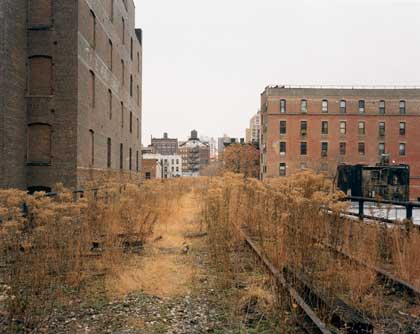
Born 1944 in New York City, Sternfeld graduated from Dartmouth College in 1965 with a BA in Art.  After studying the color theory of Johannes Itten and Josef Albers, he began making color photographs in the 1970s.  Starting out with small and medium format cameras, he eventually moved on to shoot large format, giving his work the crisp details that it is known for.  In 1987 Sternfeld released his American Prospects series, which “combined . . .  an insightful and ironic view of his subjects” (The Getty Museum).  In 1996 Sternfeld began to travel and document tragic events in American history, calling the series: On This Site: Landscapes in Memoriam.  Applying his careful use of color, Sternfeld photographed the site where Martin Luther King was murdered, and the place where Rodney King was beaten.  In 2001 with his Stranger Passing series, Sternfeld switched from landscapes to full length portraits, recording the peole he met as he traveled across America.  “Each picture tells a story via the person’s physical appearance and the rich details of their surroundings” (The Getty Musuem).  Sternfeld’s most recent series done in 2006, Earth: Esperimental Utopias in America “explores the sites of past and present idealized communities” (The Getty Museum).  Currently, Sternfeld teaches photography at Sarah Lawrence College.

Images:

http://iamgros.com/blog/wp-content/uploads/2007/03/joel_sternfeld_blanket_blog.jpg

http://caraphillips.files.wordpress.com/2007/12/sternfeld1.jpg

http://collegerelations.vassar.edu/images/releases/070525.utopian_dropcity.jpg

http://www.cabinetmagazine.org/issues/3/assets/images/main/sternfeld_2.jpg

Interview:

No interview available.

Gallery Representing artist/artist website:

http://www.luhringaugustine.com/index.php?mode=artists&object_id=67

Wednesday, September 17, 2008

Surrealism

Descriptive word: bizarre

“Surrealism, n. Pure psychic automatism, by which it is intended to express, whether verbally or in writing, or in any other way, the real process of thought. Thought’s dictation, free from any control by the reason, independent of any aesthetic or moral preoccupation."

-André Breton

Jones, Jonathan. “Arts: Andre in wonderland: In 1928 the first photobooth arrived in Paris - and for Breton and the surrealists, it was a dream come true.”  The Guardian (London).  16 June 2004, final edition: p. 12.

Jonathan Jones is a staff writer for the London Guardian newspaper.  He writes for the arts and design section of the newspaper.  In his article of AndrĂ© Breton and surrealism, he writes briefly about the rise of the surrealism revolution with its founder Breton, and the influence that it had in photography.  Jones states that Breton’s definition for surrealism is “pure physic automatism,” which flowed together well when the first automatic photo machine (called a photomaton) was invented and released in Paris.  According to Jones, “the photomaton was a readymade surrealist photography that removed the conscious, controlling mind of the photographer and took a stream of images too quickly for the sitter to compose her or himself in any but the most basic ways. The close range of the portraits and the flat background add to the sense of being surprised, taken aback, even abused, that we feel after sitting for a strip of passport pictures. The brutality that makes photomaton portraits uncomfortable makes them, for the surrealists, insightful.”  Portraiture and especially self-portraiture were very common in surrealism, because they were very fascinated by the “self.”  As Jones points out, the majority of the photomaton portraits of Breton and his group show them with their eyes closed.  In accordance with Breton’s manifesto of 1924, this will help us to recognize “the omnipotence of the dream.”  Towards the end of Jones’s article, he analyzes the photomaton portraits in a contemporary light.  Calling them “anti-aesthetic, deliberately banal, photo-based art” he believes them to be antecedents of Andy Warhol’s work.

While my work is not about examining the self or dreams, I think it can definitely benefit from the surreal movement’s exploration of the bizarre and uncanny.  Since I am experimenting in combining imagery to create a made up space, I think it is appropriate to consider the history and process behind this movement. Photography played a big part in surrealism with its departure from the ordinary use of a camera, and instead of using as a practical tool to record what is in front of it, it was used to create what the artist imagined.  I think this theory can be useful to my process.

Photo:

http://www.bbc.co.uk/photography/genius/gallery/images/ray.jpg


Saturday, September 13, 2008

Gregory Crewdson

Gregory Crewdson was born in Brooklyn, New York on September 26, 1962.  After seeing a Diane Arbus retrospective at the Museum of Modern Art in New York City, he became interested in photography.  He studied photography at the State University of New York at Purchase, where he recieved a B.A in 1985.  While there he was classmates with Jan Groover and Laurie Simmons.  Crewdson then went on to Yale for an M.F.A. in photography, which he recieved in 1988.  One of Crewdson’s early series, Natural Wonder took place in Lee, Massacusetts, where he had also shot his series of portraits for his thesis at Yale.

In 1992 Crewdson developed his Natural Wonder series, “in which birds, insects, and mutilated body parts are presented in surreal yet mundane domestic settings” (Guggenheim museum).  Crewdson’s next series, Hover, (1995) turned away from brightly colored imagery, and switched to “black-and-white bird’s-eye views of strange situations set in the streets and backyards of Lee” (Guggenheim museum). 

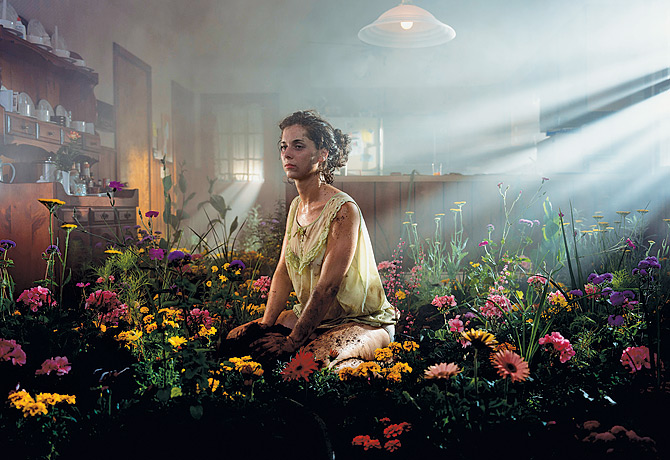
It wasn’t until Crewdson’s Twilight series in 1998 that the surreal and cinematic elements of his imagery began to emerge, as he re-introduced color into his large scale prints.  Crewdson’s photos have become more and more elaborate, “requiring dozens of assistants, Hollywood-style lighting, and specially crafted stage sets” (Guggenheim museum).  Crewdson’s photos, although set in American suburbia, are eerie and dark, and play with an element of the surreal.  Although at first glance some of his photos seem to depict normal surburbia, upon closer examination one begins to feel the tension and unease that his photographs create. 

Crewdson currently teaches photography at Yale, and lives and works in Lee, New Haven, and New York. 


Imagery:

http://coromandal.files.wordpress.com/2008/05/amstaged_0305.jpg


http://blog.camera80.ro/images/2006/november/gregory-crewdson-6.jpg


http://vienofoto.files.wordpress.com/2008/05/gregory-crewdson.jpg


http://sarahh.net/blog/wp-content/uploads/2008/06/00027gyt.jpg


Interview:

http://www.sitesantafe.org/exhibitions/virtualgalleries/frcrwan/crewdsonqa.html


Gallery representing artist:

http://www.luhringaugustine.com/index.php?mode=artists&object_id=66


No artist website available.

Wednesday, September 10, 2008

New Topographics Movement


Descriptive word: Realism

“To work in a way integrated with architecture, I think the work we’re speaking about here is not a question of putting my work in his building but a question of using that building and the activities in that building as a way of generating a dialogue in images. The work is not even site-specific, it’s really site-generated. It’s something that’s made exclusively for that space and that space with its present series of functions. In that sense it becomes like most works today ephemeral.”
Lewis Baltz

Grundberg, Andy.  “Review/Photography: Beauty and Challenge in Modern Landscape.”  The New York Times.  13 July 1990, late final ed. : C14. 

Andy Grundberg is a an art critic and administrative chair of photography at the Corcoran College of Art and Design.  In his article in the New York Times, Grundberg compares the aesthetics of the New Topographics Movement to the more contemporary “New American Pastoral” movement.  Grundberg discusses the impact that the New Topographics movement has had on the history of photographic landscapes, especially since Ansel Adams.  Grundberg points out that both the New Topographics and American Pastoral movements take a critical viewpoint when photographing landscapes.  Grundberg also discusses the different ways that artists from these two movements chose to portray the relationship between beauty and the environment.  He states about the two movements that “both reflect photographers' attempts to devise a documentary style able to call attention to environmental issues that defy conventional description.”


The New Topographics style has influenced my work in many ways.  It has made me more aware of the juxtaposition of the man-made and nature, and how we choose to view the environment that we live in.  I think the bleak anonymity of the photos in the New Topographics is an interesting departure from the romanticized landscapes that the art world had been accostomed to for so long.   I find it interesting that the desolate, anonymous, sometimes deadpan style of the New Topographics movement is clevery used to generate a narrative, using the buildings as “dialogue.”  This is ultimately my aim in creating a series of photos, but  I have yet to decide on what exactly I am trying to say. 

Images:

http://images.google.com/imgres?imgurl=http://www.mocp.org/collections/permanent/uploads/Baltz2001_5.jpg&imgrefurl=http://www.mocp.org/collections/permanent/baltz_lewis.php&h=283&w=430&sz=39&hl=en&start=9&um=1&usg=__6ncbdQwA8Ux92vWNBQHl4HPauPc=&tbnid=GUwc5-PxrU5KFM:&tbnh=83&tbnw=126&prev=/images%3Fq%3Dlewis%2Bbaltz%26um%3D1%26hl%3Den%26client%3Dsafari%26rls%3Den-us%26sa%3DG

Sunday, September 7, 2008

Complete

Paul Thulin has read your blog up to this point/entry. Your blog is currently up to date and complete.