Wednesday, October 8, 2008

Ghost Towns

Abandoned

“It  must be remembered that most ghost towns are not the result of a single factor but the product of a combination of factors.”

-       John W. Morris, author of Ghost Towns of Oklahoma

Moon, Peter.  “Abandoned bases ooze pollutants garbage: Radar stations deserted in 1965 still pollute Canada’s North.  The Globe and Mail 19 Mar. 1997, final ed.: A1.

Peter moon is a writer for Canada’s newspaper, The Globe and Mail.  In his article, he discusses abandoned former military radar stations in northern canada, some of which are located in Polar Bear Provincial Park.  Describing one of the abandoned stations, Moon states “A collection of more than 20 deteriorating buildings, rusting fuel-storage tanks and tilting communications towers, the station at Winisk on Hudson Bay looks like a ghost town. But a ghost town that is dangerous.  Asbestos is exposed and blows around. Windows and doors are broken or missing and the building walls have gaping holes through which animals, including polar bears, regularly wander.”  This site has been abandoned for over 30 years.  It has yet to be cleaned up, because the military refuses to take responsibility for the hazardous sites, and the government doesn’t have enough funds to clean it up on their own.  “The radar stations, part of what was called the Mid-Canada Line, were built by the Royal Canadian Air Force in the 1950s and abandoned in 1965. The federal and provincial governments know that the abandoned sites contain hazards to humans and wildlife, but nothing is done while they bicker about who should pay for it to be cleaned up.”   Moon’s article is an infuriating look at some of the causes for Canada’s ghost towns, and their lack of responsibility to do anything about the dangers it poses. 

After doing a little research on ghost towns, I found this article rather interesting, because Winisk isn’t your typical American ghost town that is experiencing a new surge of people due to tourism.  It isn’t a cute, folksy ghost town abandoned after the end of a gold rush.  It’s toxic, and dangerous-- a testimony to the dangers of polluting.  It also fits into my imagery, as I am trying to create unsettling, vulnerable spaces. 

foymount2-764384.JPG.jpg

Friday, October 3, 2008

Philip-Lorca diCorcia

DiCorcia was born in Hartford, Conneticut in 1951.  He studied at the School of the Museum of Fine Arts, in Boston.  He then went to Yale, where he recieved a Masters of Fine Art in photography.  DiCorcia’s style can be said to be a mix between informal snapshots and staged compositions.  Using a carefully planned staging, he takes everyday occurrences beyond the realm of banality, trying to inspire in his picture's spectators an awareness of the psychology and emotion contained in real-life situations” (Wikepedia).  This style probably developed out of diCorcia’s earlier career, where he would take family and friends and place them in fictional interior tableaus, making the viewer think that they were snapshots of the everyday life, when in fact they were staged photos.  DiCorcia then moved on to photographing random people in urban spaces around the world.  He achieved this by hiding lights in the pavement, which would illuminate a random subject in a unique way, separating them from everyone else who happened to be on the same street.  These photographs give “a sense of heightened drama to the passers-by accidental poses, unintended movements and insignificant facial expressions.  Even if sometimes the subject appears to be completely detached to the world around him, diCorcia has often used the city of the subject's name as the title of the photo, placing the passers-by back into the city's anonymity” (Wikepedia).  DiCorcia currently lives and works in New York.

Images:

http://www.albrightknox.org/acquisitions/acq_2002/images/di_Corcia.jpg


http://paulturounetblog.files.wordpress.com/2007/12/pl-dicorcia_head13.jpg


http://images.artnet.com/artwork_images_424045384_253981_philip-lorca-dicorcia.jpg


http://www.hit.ac.il/staff/ShlomoA/Photography/november/Philip-EddieAnderson.jpg


Interview:

http://www.lacan.com/frameXIV9.htm


Gallery representing artist/artist website:

http://www.icaboston.org/exhibitions/permanent-collection/artists/diCorcia/

Wednesday, October 1, 2008

Lecture on the conflict between Russia & Georgia

I attended a lecture on the conflict in Georgia, hosted by International Students for Social Equality (ISSE).  Jeff Lassahn, who is the president of the VCU chapter, spoke about the Russia -Georgia conflict, and how the conflict functions as part of a capitalist world.  Jeff began the lecture stating how the conflict began – a Georgian invasion of South Ossetia (population 70,000) , which many believe to have been planned in close collaberation with Washington.  After Russia devastated the Georgian army, they withdrew from Georgia into “breakaway provinces” which had received official Russian recognition of their own independence.  Jeff’s lecture then goes on to analyze the media’s coverage of the conflict, which he believes to be completely one-sided.  He also mentions the political hipocrisy of the conflict, with President Bush staing “Russia has invaded a sovereign neighboring state. . .  such an action is unacceptable in the 21st century” and Senator John McCain stating “In the 21st century, nations don’t invade other nations.”  It is quite obvious however, that we do.

            Jeff then goes on to analyze the U.S.’s anti-Russian stance.  Unable to comprehend why the president of Georgia would invoke the wrath of Russia, Jeff states that it is because the United Staes, who has revamped the Georgian army with U.S. equipment and technology, is “deliberately seeking a major escalation of tensions between Russia and the West.”  Jeff mentions the danger of escalating tensions with Russia, drawing parallels to the start of WWII in 1939, and quotes Leon Trotsky’s view on capitalist economy, which “means a ceaseless struggle for new and ever new fields of capitalist exploitation, which must be obtained from one and the same source, the earth.  The economic rivalry under the banner of militarism is accompanied by robbery and destruction which violate the elementary principles of human economy.”  Jeff ends his lecture mentioning the Marxist movement, stating that “the alternative of socialism needs to be critically studied and considered.” 

            While I enjoyed Jeff’s lecture, I have to say that it was definitely very one-sided.  Initially I decided to go to the lecture because I had not been following the Russian/Georgian conflict very closely, and wanted to learn the basics causes surrounding the conflict, as well as the current issues at hand.  While Jeff’s lecture certainly answered some of my questions, I walked away feeling as if I still had alot more reading to do to fully grasp all sides of the conflict. 


Gulliver’s Travels : The Houyhnhnm

Utopian

". . . he said he had been very seriously considering my whole story, as far as it related both to myself and my country; that he looked upon us as a sort of animals to whose share, by what accident he could not conjecture, some small pittance of reason had fallen, whereof we made no other use than by its assistance to aggravate our natural corruptions, and to acquire new ones which nature had not given us."

(Gulliver's Houyhnhnm master gives his damning verdict on Gulliver's fellow men)

-Jonathan Swift, Gulliver’s Travels, part IV

Philmus, Robert.  Visions and Revisions: Reconstructing Science Fiction.  Liverpool: Liverpool University Press, 2005. 

Robert M. Philmus is an acclaimed science fiction writer, as well as a retired English professor at Concordia University in Montreal.  In Philmus’s book, he dissects the langauge of utopia used in famous works of literature, one of them being Gulliver’s Travels book of The Houyhnhnms.  The Houyhnhms, who are a breed of horses, have a society based purely on reason and law, and in their perfection some words are left out of their vocabulary.  For example, since no one lies, they do not have the word ‘lie’ instead they must say “the thing which was not.”  In his book Philmus takes an excerpt from part four The Houyhnhms regarding language:

“I remember in frequent Discourses with my  [Houyhnhnm] Master concerning the Nature of Manhood, in other Parts of the World; having Occasion to talk of Lying and false Representation, it was with much Difficulty that he comprehended what I meant; although he had otherwise a most acute Judgement.  For he argued thus; That the Use of Speech was to make us understand one another, and to recieve Information of Facts; now if any one said the Thing which was not, these Ends were defeated; because I cannot properly be said to understand him; and I am so far from receiving Information, that he leaves me worse than in Ignorance; for I am led to believe a Thing Black when it is White and Short when it is Long.”

In his writing on the language of utopia, Philmus points out that the barrier in communication is just part of the Houyhnhnm society’s conceptual and physical closure from the rest of the universe.  However this closure is necessary for them to retain their utopian ideals.  Philmus stresses the importance of language for the Houyhnhnms, stating: “The Houyhnhmn’s liability to disaccreditation depends especially on (their) language: as long as their linguistic usage remains unaltered, there is no danger that the word Houyhnhnm will lose its original meaning, and with it the guarantee that they are by definition perfect.”  Through his dissection of the utopian Houyhnhnms, Philmus points  out the fragility that constantly hangs in the air, the danger lurking at every corner, threatening to collapse their uptopian world. 

Working with combining my imagery to create a made up space, I have become interested in the idea of utopia, and what constitutes and defines a utopian space.  What continues to fascinate me about the idea of utopia is the constant lack of human beings, since we are intrinsically flawed and prone to irrationality.  Reading about Swift’s Houyhnhmns was interesting to see how a constraining and vulnerable a utopian society really is. 

Image:

http://thelategreats.files.wordpress.com/2008/03/houyhnhnm.jpg 

Sunday, September 28, 2008

Michelangelo Antonioni

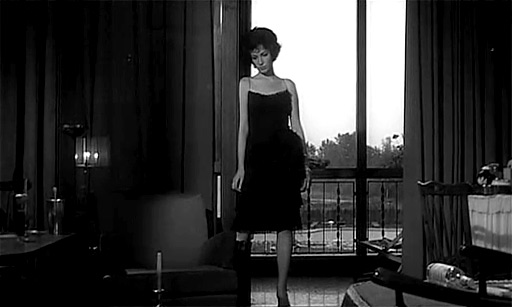
Michelangelo Antonioni was born on September 29th, 1912 in northern italy.  He died July 30th, 2007, at the age of 94.  Antonioni graduated from University of Bologna with a degree in economics, and in 1940 he moved to Rome, where he began working for Cinema, the official fascist magazine with Vittorio Mussolini as editor.  After being fired within the first few months, Antonioni enrolled at the Centro Sperimentale di Cinematografia, where he briefly studied film technique.  After three months he left, and was drafted into the army.  Antonioni began making his first short films in the 1940s, which were classified as neorealist, since they were semi-documentaries studying the lives of ordinary working class people.  In the 1950s Antonioni produced his first feature length film, this time depicting the middle class.  The style of Antonioni's films were radical and new at the time, gaining him international success.  In his film Le Amiche, he "experimented with a radical new style: instead of a conventional narrative, he presented a series of apparently disconnected events, and he used the long take frequently. This style is potentially frustrating due to its slow pacing and lack of forward momentum, although it is very fascinating in visual and conceptual terms."  These stylistic techniques soon became Antonioni's signature vision, and help emphasize his stories, which tend to be about social alienation.  Antonioni also tended to emphasize the meaningless of peoples lives, and how deep down human-beings lives are purposeless and shallow.  According to film historian David Bordwell, in Antonioni's films "Vacations, parties and artistic pursuits are vain efforts to conceal the characters' lack of purpose and emotion. Sexuality is reduced to casual seduction, enterprise to the pursuit of wealth at any cost."   Antonioni is considered very influential in the film world, and is known for "encouraging filmmakers to explore elliptical and open-ended narrative" (Bordwell).  

Images:

Interview:

Gallery representing artist:
No artist website available

Wednesday, September 24, 2008

Utopian Landscapes

Idealistic

"….This world needs Utopias as it needs fairy stories. It does not matter so much where we are going, as long as we are making consciously for some definite goal. And a Utopia, however strange or fanciful, is the only possible beacon upon the uncharted seas of the distant future."  

-       Hendrik Willem Van Loon

Lorinc, John.  “In the utopian city there’s no trash, no graffiti – and no people.”  National Post

            (Canada) 22 Mar. 2003, Saturday ed. : SP4. 

John Lorinic is an anchor and editor for CNNRadio.  In his article he discusses and reviews a book by art historian Ruth Eaton titled “Ideal Cities:  Utopianism and the (un)built environment.”  Lorinc begins his article by mentioning that as Eaton states, “the human desire to build utopian societies as a response to the grim realities of actual cities stretches back to the very dawn of civilization.”  An important figure in the Utopian movement was Le Corbusier, a “misanthropic” Swiss architect and planner, whose “mathematically inspired urban reform reached a kind of frightening apotheosis, with its dreams of megablocks and identical apartment towers sweeping away the archaic street life of old cities such as Paris.”  According to Lorinc, Eaton’s novel contains images of idealized societies that are both “arresting and seductive: One can sense how these thinkers appealed to their patrons.  Lorinc goes on to state that all of the utopian images are devoid of people, “In the elegant architectural renderings depicting Renaissance Florence and Le Corbusier's dioramas, real people are nowhere to be seen, which reveals something about the essence of utopianism.”  What Lorinc seems to be hinting at is that perhaps we have yet to achieve an utopian society because we as human beings are too complicated, messy, and unsuitable for a perfect world. 

Utopianism is slowly becoming an underlying idea in my imagery.  Creating utopic landscapes that are so pristine and devoid of any human touch that they in turn begin to look bizarre is something that really fascinates me.  Although the ultimate idea of utopia sounds pleasant enough, there is something creepy and almost totalitarian about utopian cities and living structures, where everything is organized and structured  in such a way that nothing is ever out of place, and superflous activity is discouraged. 

Image:

http://blog.roughtheory.org/wp-content/uploads/le_corbusier_vision_paris_smaller.jpg

Tuesday, September 23, 2008

Candice Breitz Lecture

Candice Breitz’s video installations speak to a range of viewers on many different levels.  Using pop culture to both question and relate to the world we interact in, her work has an air of familiarity, yet the message it conveys sometimes does not.  Using pop culture: songs, icons, celebrities, and films, Breitz attempts to speak in a language that is “shared with all urban dwellers.”  Stating that she is interested in the strange relationship between powerful public characters and an audience with no public voice, it is clear where her attraction to speak in terms of popular culture stems from. 

Breitz’s Love Song series, which reduces classics by artists such as Olivia Newton John and Whitney Houston to mere loops repeating all the “I, me, mys” and “Yous” shows her attempt to strip down the superfluous elements of the songs to what really matters: the ability to project yourself into them.  Breitz’s Mother and Father series also deal with a projection of sorts, but in a different manner.  The Mother and Father series are Breitz’s experiment at how far she can take found footage.  Cutting many different yet unorthodox mother and father characters from well known Hollywood films, Breitz shows the audience how the mainstream media is opposed to the traditional family structure, and questions Hollywood’s job as the “new parents” who are raising us.  While Brietz’s work varies from compiling found footage to prove a point, or cutting and editing it to create a new one, it always manages to raise interesting questions about the world we interact in.