Thursday, October 30, 2008

Lecture # 4 Media and the Election

I attended this seminar given by Bonnie Newman Davis, a professor at VCU in the Masscommunications department.  Seeing as the presidential election is just 6 days away, it was a very interesting and revelant topic to discuss.  Some of the key points Bonnie went over were:

-The fact that the media has been overwhelmingly supportive of Obama’s campaign.

-What is the media’s fascination with Sarah Palin?

-How effective were the debates?

-Has the large media coverage of Obama swayed voters?

Bonnie brought guest lecturer’s from Jim Webb’s political team, as well as a journalist from the Times Dispatch, to ask them their opinions.  By the end of the lecture, it was pretty clear that the reason Obama and Palin have been getting way more political coverage than any other president or vice-president candidates is because they are young, fresh, and a break in the trend of past politics.  Also discussed was the issue of sex and politics.  Many media sources play up the fact that Palin is female, and label any disputes or arguments against her as ‘misogynistic’ or ‘anti-feminist.’  I disagree with this.  When Palin agreed to run for VP, she put her self in the public eye, and therefore subjected herself to criticism.  Also, Palin tends to favor playing the gender card herself: she constantly makes references to hockey moms, lipstick, high heels, and totes her kids around with as she campaigns, as if they were props.  While my bias is quite clear, Bonnie tried to keep her opinions out of the discussions, which made for a  fair and in-depth analization of the media’s coverage of this presidential election.  

Tuesday, October 28, 2008

Compound Communities


Combined

“The compound house has long provided the accommodation required by low-income households in West African cities.”

-   Jørgen Eskemose Andersen

Andersen, Jorgen, Andreasen, Jorgen, and Tipple, Graham.  “The demise of compound houses – consequences for the low income population of Kumasi, Ghana.” RICS Research vol. 6 num. 8 Mar. 2006: 5-35.  28 October, 2008. 

Andersen and Andreasen are associate professors at the Royal Danish Academy of Fine Arts, as well as architects and town planners.  Graham Tipple is a Reader in Housing Policy and Development and an Associate Director of the Global Urban Research Unit in the School of Architecture at the University of Newcastle in Tyne, UK.  In this collaborative research paper, the authors discuss the key role compound housing has provided in low-income cities in West Africa.  The essay analyses the advantages and disadvantages of compound housing.  “Issues of privacy, image and communal life are usually cited by occupants dissatisfied with life in compound houses” state the authors in regards to complaints about compound living.  They then go on to state that: “However, they [compound housing] represent good value for money, cost little to build, suit traditional inheritance patterns, allow independent life at low cost, and allow sharing of services with a finite and known group.  Compound housing is also compact and suited to hot climates. It is noted that multi-habitation occurs in houses of other designs but the courtyard is replaced by access corridors, with some loss of amenity.”  The rest of the essay examines different compounds in different parts of West Africa, and brings up the fact that instead of new compounds being built, the cities are seeing “affluent villa-style” developments.  The three authors then conclude that there is a definite need to develop “new forms of housing with the advantages of compound housing but which fit into new perceptions of what is acceptable urban life to the growing cohort of young family households.”


Reading about compound housing was interesting and beneficial.  While I am not looking to photograph compound neighborhoods, I am looking for pre-fabricated buildings, or buildings that were designed with minimal cost in mind.  After reading this essay, it was made quite clear that saving money and using cheap material/minimal space is one of the allures for architects and city planners when designing compound communities.  Keeping this in mind, I will continue to look for buildings to photograph in more run-down, or impoverished places, since they will generally reflect the economic standings of the area.  


Friday, October 24, 2008

Richard Serra

Richard Serra was born in San Francisco in 1939.  He attended University of California both and Berkley and Santa Barbara, and graduated in 1961 with a B.A. in English Literature.  Before attending Yale for gradschool, he worked in steel mills in order to support himself.  In 1964 he graduated from Yale, having obtained both a BFA and MFA.  Serra’s work that emerged in the 1960’s, and “focused on the industrial materials that he had worked with as a youth in West Coast steel mills and shipyards: steel and lead. A famous work from this time involved throwing lead against the walls of his studio. Though his casts were created from the impact of the lead hitting the walls, the emphasis of the piece was really on the process of creating it: raw aggression and physicality, combined with a self-conscious awareness of material and a real engagement with the space in which it was worked” (Art:21).  Always working in the minimalist style, his work is now famous for that physicality, only on a much larger scale.  In 1996 he released his “Torqued Ellipses” series “which comprise gigantic plates of towering steel, bent and curved, leaning in and out [and] carve very private spaces from the necessarily large public sites in which they have been erected” (Art:21).  Serra’s most recent work is a 60 foot-tall “Charlie Brown” monument which is erected in the courtyard of a San Francisco office.  Currently Serra lives in New York and Nova Scotia.

Images:

http://images.google.com/imgres?imgurl=http://www.diacenter.org/exhibs_b/serra/serra-exhibs_b-top.jpg&imgrefurl=http://www.diacenter.org/exhibs_b/serra/&h=405&w=320&sz=20&hl=en&start=20&um=1&usg=__FQiNHN56zRhEenjFy7IcxD6GPo0=&tbnid=4LqeHpV5UBG6zM:&tbnh=124&tbnw=98&prev=/images%3Fq%3Drichard%2Bserra%26um%3D1%26hl%3Den%26client%3Dsafari%26rls%3Den-us%26sa%3DN

http://www.akiraikedagallery.com/RichardSerra_MarilynMonroeGrataGarbo2.jpg

http://img.timeinc.net/time/photoessays/2007/richard_serra/richard_serra_09.jpg

http://upload.wikimedia.org/wikipedia/commons/d/dd/Richard_Serra_View_Point.jpg

Interview:

http://www.pbs.org/art21/artists/serra/clip2.html

Gallery representing artist/artist website:

http://www.gagosian.com/artists/richard-serra

Thursday, October 23, 2008

Lecture # 3: Obama Rally

I attended the Barack Obama presidential rally at the Richmond Colesium.  It was really incredible to see 13,000 people waiting in line to hear Obama speak.  When Obama finally came onto the stage, he spoke about the liklihood of becoming the next president of the United States.  While he seemed confident that he will win, he didn’t forget to remind the audience that it would be a constant struggle, both now and after he gets elected.  He was referring to the economic crisis, and was smart in pointing out that there is no quick fix, and it will take several years and sacrifice on everyone’s behalf in order to restore balance to the economy.  Obama then went on to discuss the negative-anything-goes politics that are occuring in the form of automated telephone calls and mailings.  While realizing that these are part of any campaign, he addressed the issue that Americans should not be focusing on cut-throat propaganda, but what each candidate is promising to deliver.  He then proceeded to go over the key points of his campaign: healthcare, the war in Iraq, renewable sources of energy, and his tax plan.  I am really glad I was able to attend the rally; it was amazing to see Obama in person, and to see all of his supporters in the Richmond area gather together in one place.  As the election approaches, the possibility of Virginia being a blue state and playing a critical role continues to loom – I am glad I got to witness a piece of history right here in Richmond.  

Wednesday, October 22, 2008

Minimalist Photography

Nominal

“Basically, what you really want to do is try to engage the viewer's body relation to his thinking and walking and looking, without being overly heavy-handed about it.”

-- Richard Serra

McFarlane, Robert.  “Stripping down to the bare minimum.”  Sydney Morning Herald (Australia) 10 May 2000, late ed.: pg. 14. 

Robert McFarlane is a documentary photographer, specializing in social issues and documenting performance within film and theatre.  He is also a writer for the Sydney Morning Herald, B + W magazine as well as a few others. In his article McFarlane critiques several shows in the Sydney area, many of which claim to be minimalist.  One show that seems particularly interesting is titled Minimal and is curated by Alasdair Foster.  The show conists of works by nine photographers, and Foster draws comparisons between music and photography, stating “minimalism has inflected (sic) .. avant-garde film scores and popular music, [whereas] photography has been obsessed with detail and ... the medium of evidence".  As McFarlane critiques various artists from various galleries, questioning whether or not their work is really minimalist.  McFarlane eventually comes to the conclusion after dissecting the artist’s work that “Photography pure and simple, epic and contrived, fills out what is an unusually dense month of exhibitions in Sydney.”

Reading this article was interesting to me, because I was able to see into the eyes of an experienced photo critic, and understand from his point of view what constitutes minimal photography, and if the minimalist style is always justified in its use.  While my work is certainly not classified as minimalist photography, I am hoping that if executed correctly, it will have a minimalist feel, perhaps in the attention to detail. 

Image:

http://www.kultureflash.net/archive/68/images/sugimoto3.jpg 

Tuesday, October 21, 2008

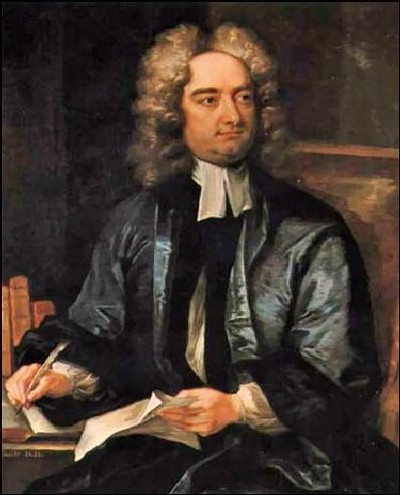
Jonathan Swift

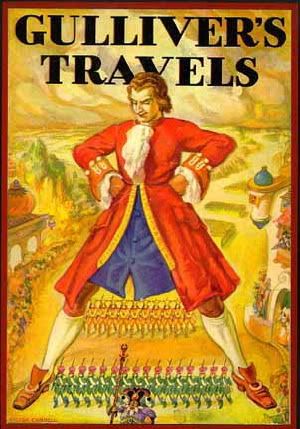
Jonathan Swift was born in Dublin, Ireland November 30th, 1667.  During his lifetime Swift was an Anglo-Irish satirist, an essaysit, and a poet.  He also worked for the Whigs and then the Tories as a political pamphleteer.  His best known work is Gulliver’s Travels.  He is also well known for A Modest Proposal, A Journal to Stella, Draipier’s Letters, The Battle of the Books, An Argument Against Abolishing Christianity, and A Tale of Tub.  According to Wikepedia, “Swift is probably the foremost prose satirist in the English language, and is less well known for his poetry.”  Swift attended Dublin University in 1682, where he recieved his B.A.  When political troubles arose in Ireland due to the Glorious Revolution, Swift was forced to flee to England, where he obtained a posistion as secretary to Sir William Temple, an English diplomat.  In 1692, Swift recieved his M.A. from Hertford College, Oxford University.  In 1694 Swift was ordained a priest in the Established Church of Ireland.  During the years 1707 to 1709 Swift became very politically active.  During the 1720’s Swift began writing Gulliver’s Travels, back then known as Travels into Several Remote Nations of the World, in Four Parts, by Lemuel Gulliver, first a surgeon, and then a captain of several ships.  Lemuel Gulliver was one of Swift’s pseudonyms that he published work under.  According to Wikepedia, Much of the material reflects his political experiences of the preceding decade. For instance, the episode when the giant Gulliver puts out the Lilliputian palace fire by urinating on it can be seen as a metaphor for the Tories' illegal peace treaty; having done a good thing in an unfortunate manner.”  Swift’s health began to decline the in the late 1730s and early 1740s, many disputing whether or not he was also insane.  In 1742 Swift suffered a stroke and lost the ability to speak. He died October 19th, 1745.  Swift is considered a master of both the Horatian and Juvenalian styles of satire. 

Images:

http://upload.wikimedia.org/wikipedia/commons/7/7e/Jervas-JonathanSwift.jpg

http://members.shaw.ca/stodmyk/misc/GulliverLeashed.jpg

http://i23.photobucket.com/albums/b360/lilliputhome/gullivers_travels.jpg

http://blog.sixwise.com/photos/images/images/91/555x360.aspx

No interview is available.

Website:

http://cepa.newschool.edu/het/profiles/swift.htm

Wednesday, October 15, 2008

Improbable Utopia

Unattainable

“Utopia, imaginary and ideal country in Utopia (1516) by Sir Thomas More, from Greek ou not, no + topos place

Date: 1597

1: an imaginary and indefinitely remote place

2: often capitalized: a place of ideal perfection especially in laws, government, and social

conditions.

3: an impractical scheme for social improvement.”

            -Merriam-Webster

Wilson, David.  “The Dream of Utopia Begets Monsters.”  The Globe and Mail 17 November 2007 Saturday ed.: D3. 

David Wilson is a professor of history and Celtic studies and University of Toronto.  In this article he discusses the book Black Mass: Apocalyptic Religion and the Death of Utopia by John Gray.  Gray’s book discusses the role of faith and religion as influencing what one would consider to be an ‘utopia.’  Wilson states that in Gray’s book, “he also contends that disparate forms of utopianism are rooted in apocalyptic forms of Christianity.  Secular utopias, Gray argues, are ‘vehicles for religious myths’.”  Wilson goes on to state that when it comes to dissecting the idea of utopia, both he and Gray are on the same page.  Wilson believes that: ‘the attainment of a peaceful and harmonious world breaks down on the contradictory nature of human needs, the incompatibility of human values and the flaws of human nature. And the quest for utopia produces nightmares; wherever and whenever a state has attempted to create an ideal society and a new type of human being, the result has been mass death - which is justified as weighing lightly in the scale when balanced against the establishment of Heaven on Earth.”  Gray’s book goes on to discuss the faults of utopia, the failed use of it by religious sects, and even President George W. Bush’s utopian fantasy of “ridding the world of evil” and the “war on terror.”  

Reading the article was interesting because I was able to see just how far the idea of utopia reaches.  It was also helpful to understand the history of utopia, how it got started and who actually tried to put it into effect.  The article also reinforces my belief that utopia is completely unattainable and for good reason: it usually involves loss of personal rights or dictatorship.  I continue to be drawn to the idea of creating visually manipulated and controlled environments that verge on eerie.  Understanding the background and attempted practices of this concept will be useful as I look for more areas to photograph.    

Image:

http://www.walkbook.net/satis/ADMIN/IMAGES/URUN/U49.jpg